A staging environment, where implementation specialists configured all customer-specific business rules.
B2B · SaaS · HR Technology
TOTVS · 2026
Reducing Enterprise Customer Onboarding from Weeks to Minutes
My Role
Throughout the project I was responsible for:
✓Leading discovery activities
✓Conducting qualitative research with implementation specialists
✓Mapping business requirements
✓Facilitating discussions with Product and Engineering
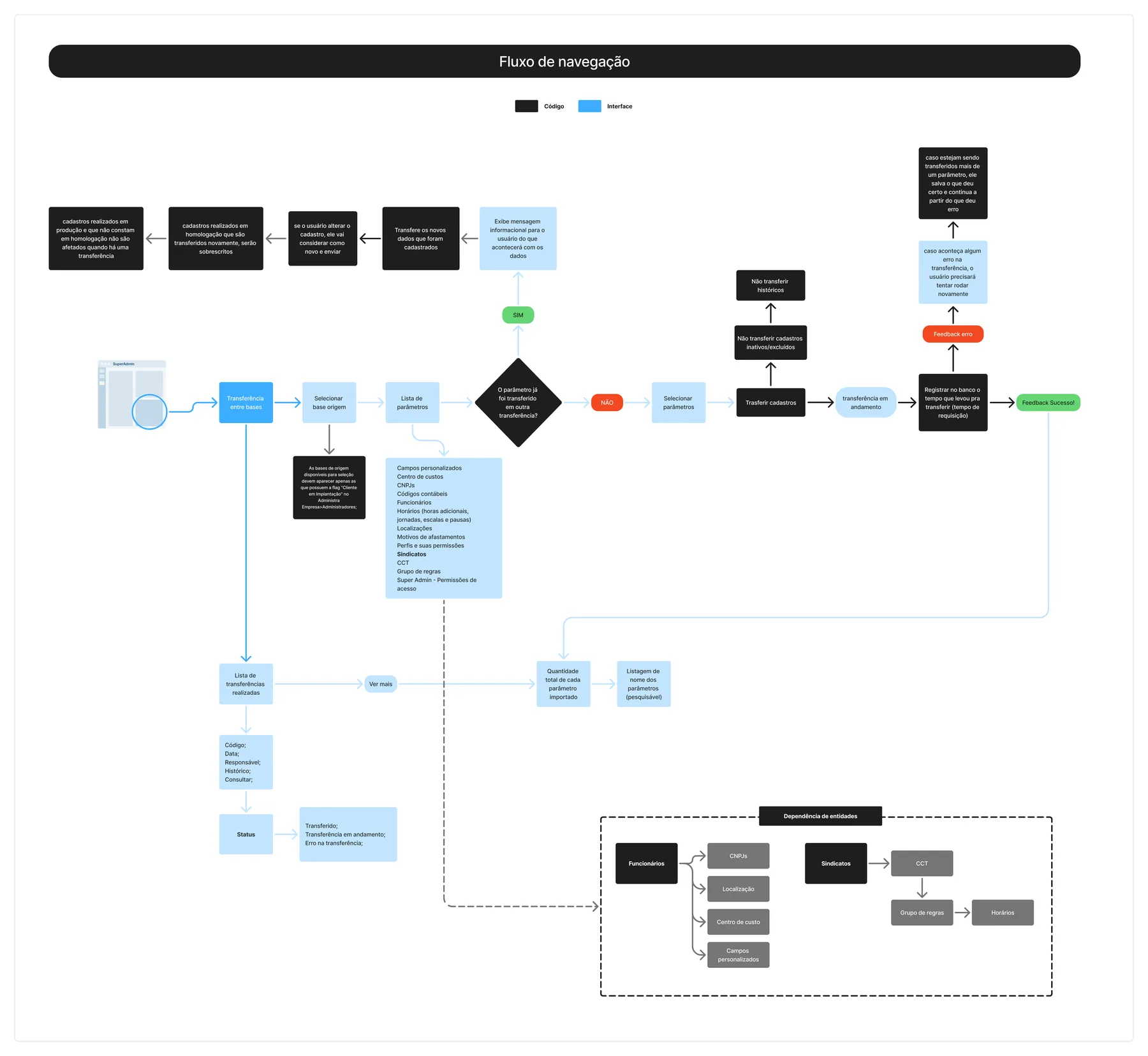
✓Designing navigation flows
✓Creating the final user experience
Overview
This project was developed for an enterprise HR platform used to manage employee time tracking and payroll rules.
One of the biggest bottlenecks affecting the product's revenue wasn't inside the software itself—it was the implementation process.
Enterprise customers required a highly customized environment before going live, and implementation specialists were spending one to two weeks manually configuring customer environments before clients could start using the product.
Our goal was to dramatically reduce implementation time while minimizing manual work and human error.
The Challenge
The implementation process relied on two different environments:
A production environment, where those same configurations had to be recreated manually.
The challenge was to design a solution capable of automating this transition while respecting the platform's complex business rules.
Duplicated work created several problems
Long onboarding times
Manual data transfer
High risk of configuration errors
Increased implementation costs
Slower Time to Value (TTV)
Discovery
Understanding the existing workflow
I started by working closely with the Product Owner and senior implementation specialists to fully understand the existing workflow.
To structure the investigation, I used two internal discovery frameworks that I developed over the years, together with a CSD Matrix (Certainties, Assumptions and Doubts).
The first framework helped answer
01Why are we solving this problem?
02Who are we designing for?
03What needs to be accomplished?
04Which data do we already have?
05How can we summarize the problem?
This process allowed the team to clearly define the business objective before exploring solutions.
Initial Findings
Implementation had become a major bottleneck
1–2
weeks configuring each enterprise customer
Time to Value
Implementation was delaying customer onboarding and increasing operational costs.
Organizing Assumptions
CSD Matrix
Using the CSD Matrix, I organized everything the team already knew, what we believed could be true, and which questions still needed validation.
We knew
- Parameters had to be manually recreated in production.
- Manual configuration generated frequent customer complaints.
- The implementation team spent significant time repeating the same work.
We assumed
Most configuration parameters could be transferred automatically between environments.
We needed to validate
- Which parameters were actually transferred?
- Could they be grouped?
- Did they require transformation?
- How much time was being spent on manual transfers?
User Research
Understanding internal workflows
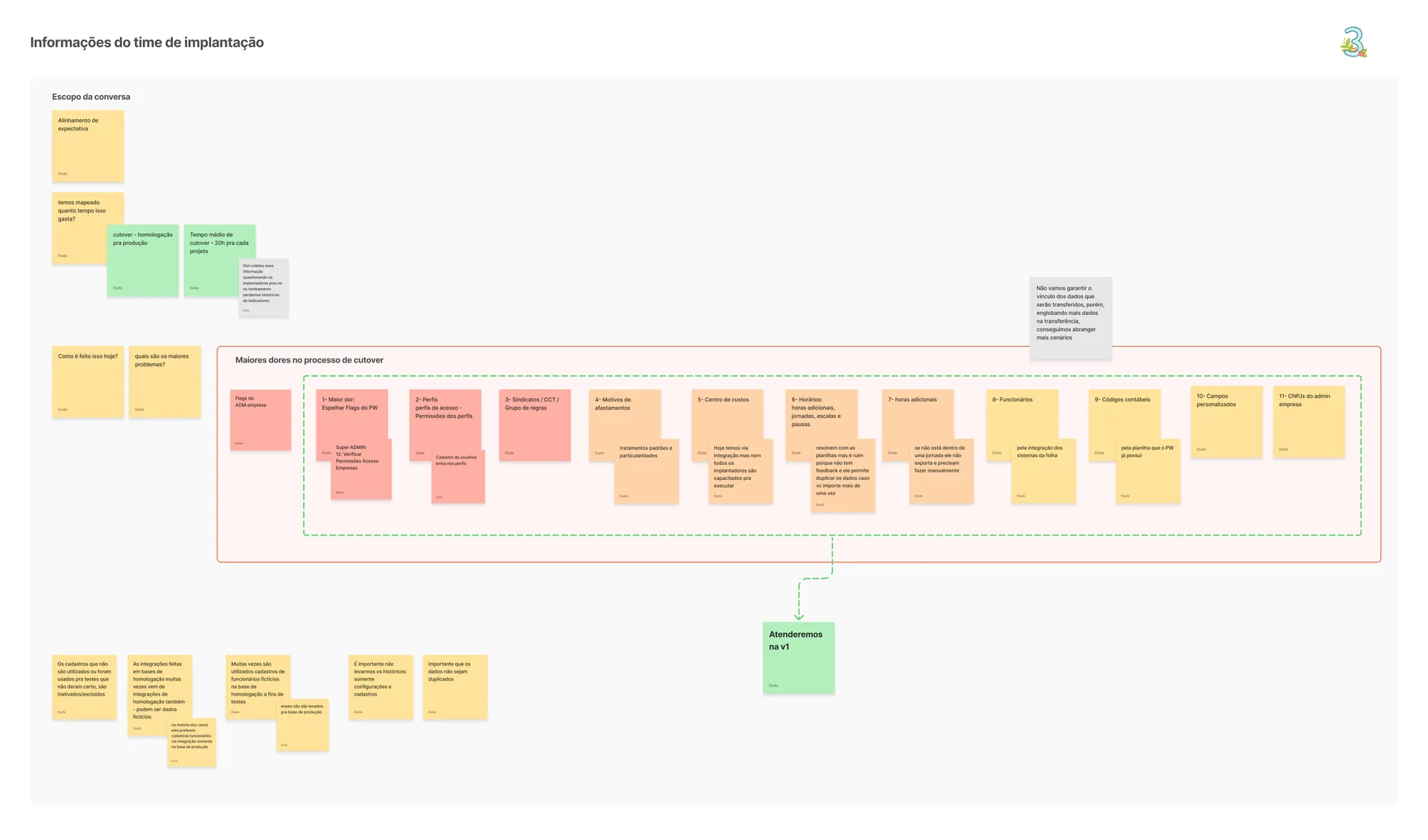
To answer these questions, I conducted qualitative research with implementation specialists.
The goal wasn't to understand end users—it was to deeply understand the workflow of the internal teams responsible for customer onboarding.
This research allowed me to map every configuration currently transferred between environments, including:
✓Access profiles
✓Labor union rules
✓Cost centers
✓Work schedules
✓Overtime rules
✓Employee data
✓Accounting codes
✓Custom fields
✓Company configurations
Rather than treating every parameter equally, I also classified them according to implementation complexity.
This prioritization became the roadmap for incremental delivery, allowing Engineering to automate the highest-impact configurations first.
From Research to Requirements
Once the research was complete, every mapped configuration became a functional requirement.
These findings served as the foundation for collaborative ideation sessions with Product and Engineering.
✓Technical feasibility
✓Processing costs
✓User efficiency
✓Business impact
Together, we explored different information architectures until arriving at a solution capable of balancing:
Solution
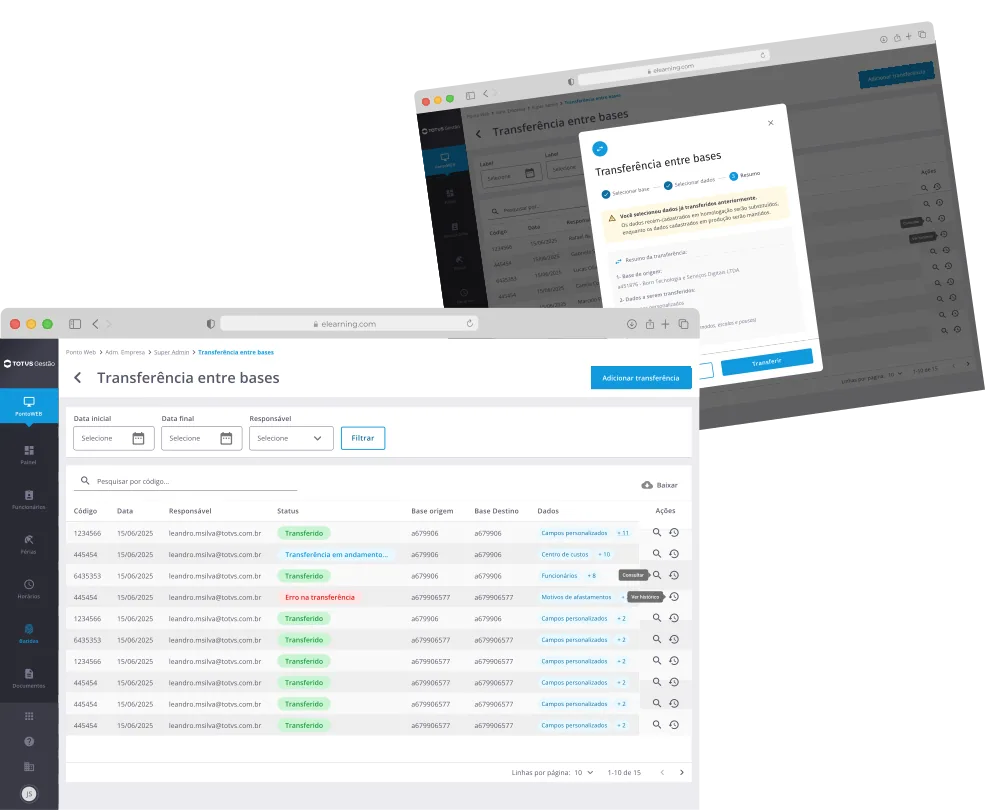
The final solution introduced an automated parameter transfer flow between staging and production environments.
Instead of manually recreating every configuration, implementation specialists could simply:
- ✓Select which configuration groups should be transferred
- ✓Review the selected items
- ✓Execute the transfer automatically
The solution eliminated repetitive copy-and-paste work while significantly reducing configuration errors.
I designed both the navigation flow and the product interface that supported this new workflow.
Before
- ●1–2 weeks to complete customer implementation
- ●Manual configuration
- ●High risk of human error
After
- ●Configuration completed in minutes
- ●Automated parameter transfer
- ●Significantly fewer manual errors
- ●Faster customer onboarding
- ●Reduced operational effort for the implementation team
Outcome
This project reinforced that great product design isn't only about improving the user experience—it can also transform business operations. By reducing implementation time from weeks to minutes, we accelerated customer Time to Value, increased the implementation team's operational capacity, reduced operational costs, and improved productivity. It also demonstrated the value of combining structured discovery, user research, and close collaboration with Engineering to simplify highly complex enterprise workflows.